

WhatsApp has become a core business channel in India in 2026, helping brands drive customer engagement, sales, support, and retention from a single conversational platform. With more than 550 million users in India, WhatsApp has moved well beyond personal messaging to become an important part of how businesses communicate with customers.
For growth leads, marketing directors, and business founders, this shift is changing how customer acquisition and retention strategies are built. Traditional email campaigns and SMS notifications still have their place, but businesses increasingly need WhatsApp marketing platforms to run personalized campaigns, automate conversations, recover leads, provide support, and track customer interactions at scale.
How Fast WhatsApp Business Adoption Is Growing in India
Business messaging is growing rapidly across India:
- Widespread Usage: More than 95% of smartphone users in India use WhatsApp daily, making it a key digital channel for businesses.
- Strong Customer Engagement: Over 91% of online adults in India reportedly message businesses each week for product inquiries, support, or order updates.
- Higher Engagement: Traditional email campaigns often see open rates of around 15-20%, while WhatsApp Business messages can achieve open rates of up to 98% and click-through rates above 45%.
As digital advertising becomes more expensive and third-party cookies become less useful, businesses are shifting more of their marketing budgets toward direct, conversational channels like WhatsApp.
Five Trends Shaping WhatsApp Marketing This Year
Here are the critical operational and technology shifts defining the WhatsApp ecosystem:
1. AI-Assisted Chatbot Flows Replacing Static Auto-Replies
Generic away messages and rigid decision-tree bots are being replaced by dynamic AI agents. Today's conversational engines understand natural language, interpret complex user intent, pull real-time inventory from CRMs, and resolve up to 80% of routine support queries autonomously.
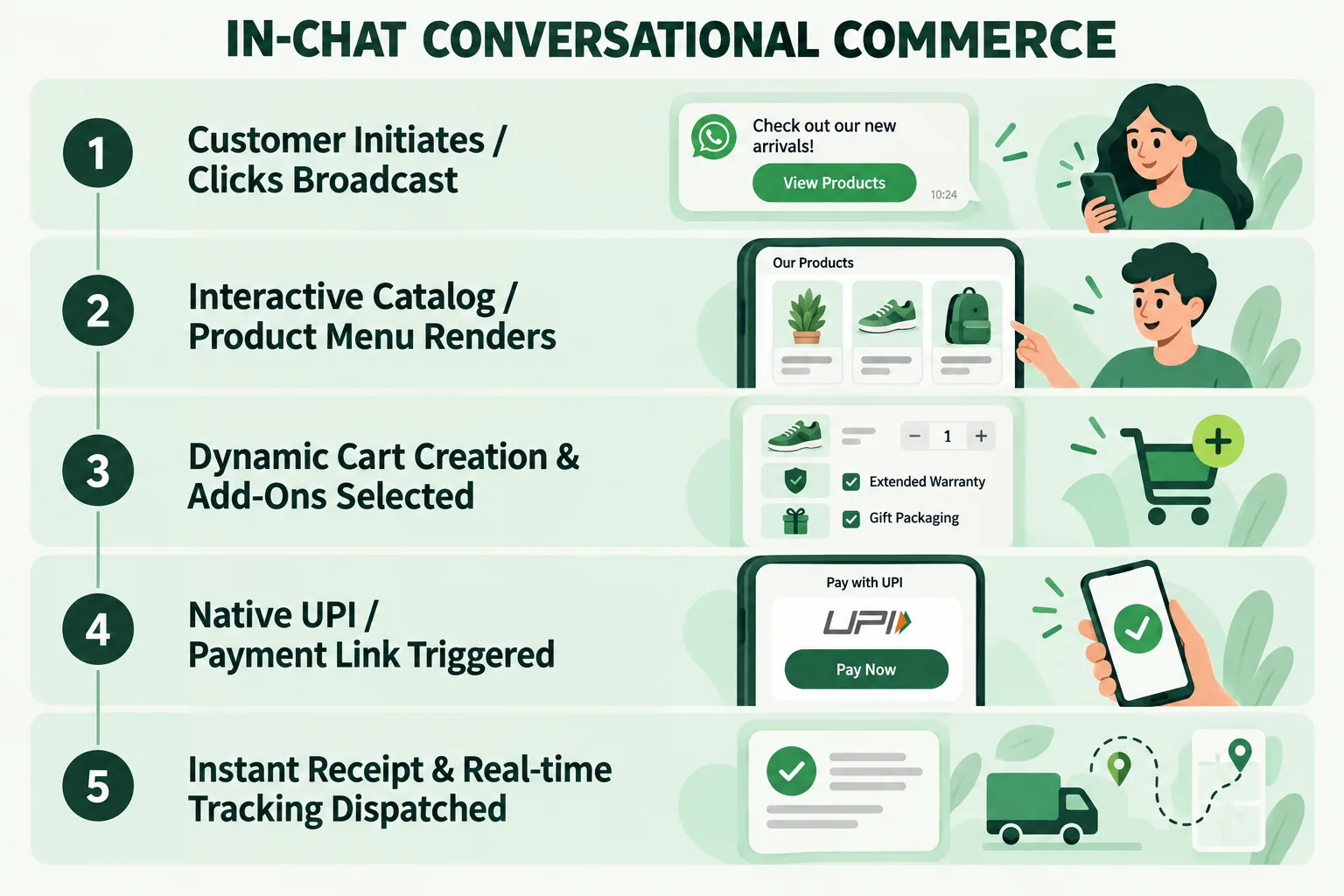
2. End-to-End WhatsApp Commerce & Native UPI Payments
The messaging thread is now a complete storefront. Driven by deep integrations with native catalog tools and UPI payment rails, customers can browse multi-item catalogs, select customized options, apply promotional codes, and complete instant checkout without ever leaving the chat.
3. Per-Message Delivery Rates & Smarter Audience Segmentation
Meta's transition to a standardized per-message delivery fee model reinforces the need for hyper-targeted audience segmentation. Rather than blasting generic marketing messages to unsegmented lists, high-performing brands use zero-party data and CRM purchase histories to deliver personalized, relevant campaign broadcasts.
4. Hyper-Personalized First-Party Data Integration
Modern messaging engines connect directly with central data warehouses, Shopify stores, and CRMs. This allows brands to automate lifecycle triggers such as personalized reorder reminders based on average usage cycles, back-in-stock alerts, and COD verification prompts.
5. Multi-Channel Convergence via Click-to-WhatsApp Ads
Top-of-funnel ad strategies across Instagram and Facebook are moving heavily toward CTWA formats. Instead of sending paid traffic to low-converting web landing pages, businesses route users directly into an interactive WhatsApp chatbot flow, drastically cutting lead acquisition costs.
What This Means for Businesses Still on Email or SMS
Relying exclusively on traditional outreach channels leaves businesses at a competitive disadvantage:
Performance Indicator | SMS & Email | WhatsApp API |
|---|---|---|
Open Rate | 10%-20% | 80%-98% |
Engagement/CTR | 1%-3% | 15%-45% |
User Experience | Mostly one-way messages | Interactive, two-way conversations |
Spam & Trust | More likely to be filtered as spam | Verified business profiles build trust |
For a deeper dive into channel performance comparisons, review our detailed guide on WhatsApp Marketing Platform vs Email Marketing.
How Wydely Customers Are Already Using These Trends
Wydely helps growing businesses make the most of WhatsApp with a simple, transparent messaging platform:
- Transparent Meta Rates: Send utility, authentication, and marketing messages at Meta’s official rates, with no extra per-message software charges.
- No-Code Chatbot Builder: Create AI-powered chatbots, menus, and agent handoffs without coding.
- Shared Team Inbox: Let sales, support, and account teams manage customer conversations from one official WhatsApp number.
FAQs: WhatsApp Marketing Trends in India
Q1. How does WhatsApp marketing work for businesses in India?
WhatsApp marketing lets businesses communicate with customers through campaigns, automated messages, chatbots, product catalogs, and customer support. Using the WhatsApp Business Platform, businesses can also connect WhatsApp with their CRM, website, or other business tools.
Q2. Is WhatsApp marketing effective for Indian businesses?
Yes, WhatsApp can be an effective channel for customer communication because it supports direct, two-way conversations. Businesses can use it for lead follow-ups, order updates, customer support, promotions, and repeat purchases.
Q3. Is WhatsApp marketing legal in India?
Yes, businesses can use WhatsApp for marketing in India, but they must follow applicable privacy, consent, messaging, and WhatsApp Business Platform rules. Businesses should only message customers in accordance with the required consent and opt-out requirements.
Q4. How much does WhatsApp marketing cost for a small business in India?
The cost depends on the WhatsApp Business Platform provider, software plan, message volume, and Meta's applicable messaging charges. Small businesses should compare both platform fees and per-message costs before choosing a provider.
Q5. How can businesses use WhatsApp marketing to generate leads in India?
Businesses can use Click-to-WhatsApp Ads, website buttons, QR codes, forms, and social media campaigns to bring prospects into WhatsApp. Automated questions and chatbot flows can then qualify leads before passing them to a sales agent.